
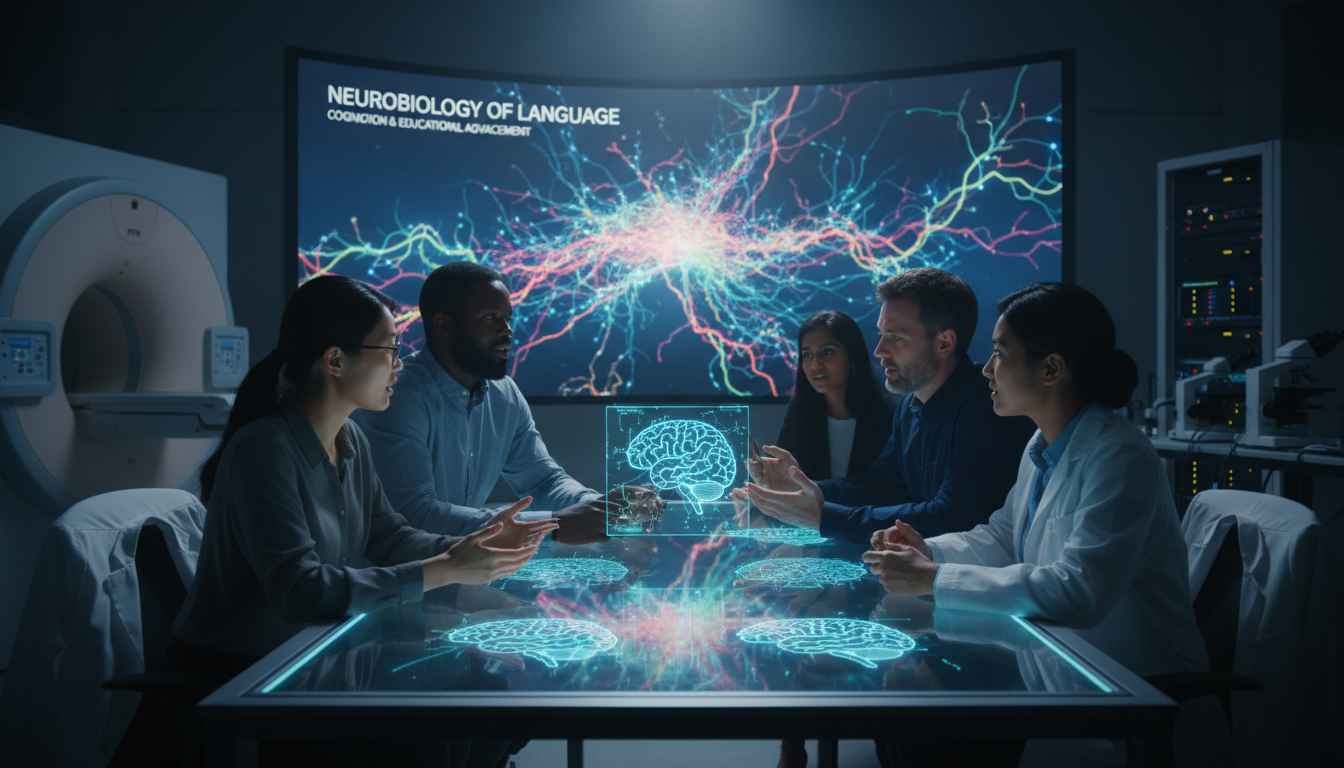
This might hurt your feelings. The human brain, in all its messy complexity, is far more than a vessel for thought. It is a dynamic orchestra of neural circuits that underpin our ability to produce, comprehend, and even manipulate language. The society of neurobiology of language, an often-overlooked niche within cognitive neuroscience, has been quietly mapping these circuits, revealing insights that challenge long-held assumptions about how we communicate.
For decades, linguists and neuroscientists operated in parallel worlds. Linguists meticulously charted syntax, semantics, and phonology, while neuroscientists focused on gross brain structures and functions. Only recently have these disciplines converged in a rigorous attempt to understand how language emerges from neural activity. According to Dr. Elaine Kovacs, a leading neuro-linguist at the University of Chicago, “The language system is not a monolith but a highly distributed network. Understanding its neurobiology forces us to reconsider what it means to ‘know’ a language.”
The society of neurobiology of language has been instrumental in bridging this gap. Its members, often at the intersection of neuroscience, psychology, and computational modeling, aim to uncover the biological underpinnings of speech and comprehension. Functional MRI, diffusion tensor imaging, and electrophysiology have become standard tools, revealing that even seemingly mundane linguistic tasks recruit complex, multilayered brain circuits. For instance, reading a simple sentence activates areas in the left inferior frontal gyrus, temporal cortex, and surprisingly, subcortical regions like the basal ganglia.
Beyond basic research, the society has also emphasized applied neuro-linguistics. Understanding the neural basis of language acquisition can inform therapies for aphasia, dyslexia, and other language disorders. Members advocate for translational research that moves discoveries from lab benches to classrooms and clinics. Interestingly, this approach has drawn some crossover with cognitive ergonomics and even artificial intelligence. As AI systems increasingly simulate human-like language, insights from neurobiology are shaping algorithms that mimic neural patterns of comprehension and production.
Engagement with the public has also been a priority. Institutions like America’s Car Museum may seem unrelated, but their commitment to education mirrors the society’s approach: making complex systems tangible. Just as a museum contextualizes the evolution of automobiles, neuro-linguists aim to demystify the evolution of neural circuits that enable language. These initiatives often include interactive exhibits, public lectures, and hands-on workshops, underscoring that the brain’s architecture is not only fascinating but accessible to non-specialists.
Key Research Trends and Emerging Insights
Recent studies have shifted focus from classical Broca and Wernicke regions to network-level analyses. Graph theory and connectomics reveal that language processing involves dynamic integration across hemispheres, not just isolated left-hemisphere structures. This challenges traditional localizationist models and suggests that language comprehension may be more robust and flexible than previously thought.
Another exciting frontier is the study of neuroplasticity in bilinguals. Research shows that early bilingual exposure strengthens white matter tracts and enhances executive control networks. Dr. Miguel Alvarez, a cognitive neuroscientist at Stanford, notes, “Language is not just learned; it physically reshapes the brain. Our society is beginning to quantify these changes with unprecedented precision.” These findings have implications for education, cognitive rehabilitation, and even social policy regarding multilingualism.
Joining a musical community can be a transformative experience, offering individuals the chance to enhance their musical skills, connect with like-minded individuals, and contribute to a larger artistic vision. One such organization that embodies this vibrant spirit is the buffalo choral arts society, which provides a rich environment for singers of all levels. However, as with any commitment, there are both pros and cons to consider before diving in. This article will explore the benefits and challenges of becoming a member of such an inspiring community, helping you make an informed decision about your musical journey.
Potential Drawbacks and Who Should Avoid This
While the field is thrilling, it is not without limitations. Experimental paradigms can be expensive, technically complex, and sometimes ethically delicate. Studies often rely on small, homogenous samples, which can skew interpretations. Additionally, overreliance on neuroimaging data risks reducing the richness of language to mere activation maps, ignoring sociocultural contexts that also shape communication.
Individuals seeking quick fixes for learning languages or artificial intelligence enthusiasts hoping for one-size-fits-all neural blueprints may be disappointed. The society’s work is inherently incremental, nuanced, and sometimes painfully slow. It rewards patience, precision, and a willingness to embrace ambiguity – traits not everyone enjoys.
Expert Rating
Scientific Rigor: 9/10
Practical Applicability: 7/10
Public Engagement: 8/10
Innovative Potential: 9/10
Looking Forward
The future of the society of neurobiology of language appears to be both collaborative and integrative. Advances in machine learning, multi-modal neuroimaging, and large-scale data analytics promise to illuminate previously opaque neural processes. Beyond academic prestige, this research has tangible societal implications: improved language education, targeted therapies for neurological disorders, and even deeper understanding of human cognition itself. For those willing to engage with its complexities, the society offers an intellectual adventure unlike any other.
In conclusion, the society of neurobiology of language is more than a research collective – it is a testament to human curiosity, a fusion of art and science that continuously reshapes our understanding of communication. As our technological and analytical tools improve, the nuances of language’s neural substrate will be revealed in ways that are both unexpected and profound. This is a field for those who embrace the beautiful messiness of the human mind and seek answers in its most intricate circuits.
